Article Open Access

Methanol Poisoning - Outbreak Dynamics and Therapeutic Uncertainties in Rural India

Sangeetha Kandasamy1, Shivkumar Gopalakrishnan2, Jay Adhithyan1, Vaithiyanatha Purushothaman3
1 Government Villupuram Medical College and Hospital, Department of Biochemistry, Tamil Nadu, India
2 Government Villupuram Medical College and Hospital, Department of Emergency Medicine, Tamil Nadu, India
3 Government Villupuram Medical College and Hospital, Department of Community Medicine, Tamil Nadu, India
DOI: 10.4274/globecc.galenos.2025.29484 Article ID: GECC-35827
Abstract
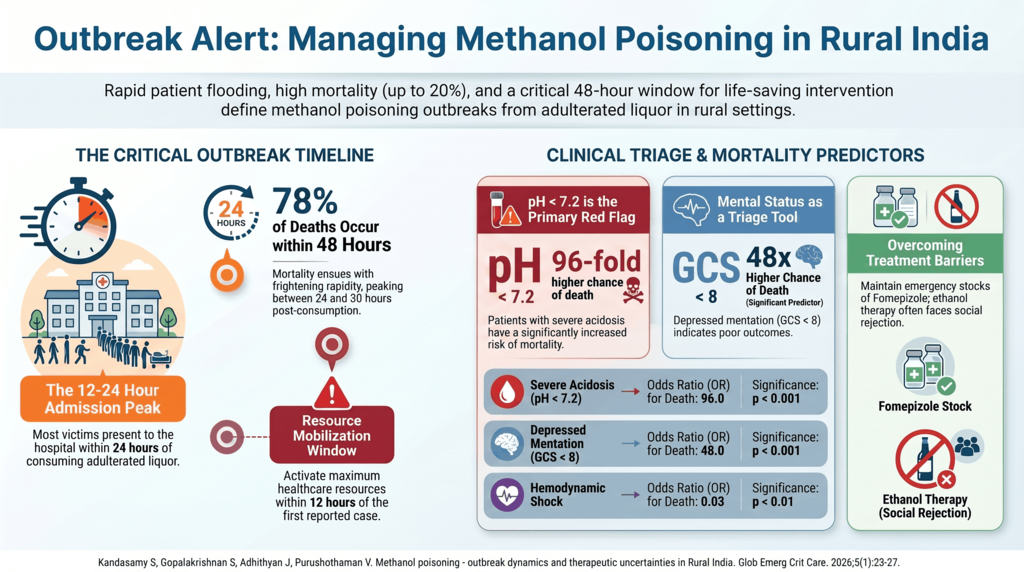
Objective: Methyl alcohol poisoning in India occurs as explosive outbreaks with mortality rates reaching 20%. Rural hospitals are often ill-equipped and lack expertise in handling such crises. The purpose of this work is to emphasize our experience regarding outbreak dynamics, clinical triage, sociocultural influences impacting treatment, and mortality predictors.
Material and Methods: This was a hospital-based retrospective descriptive study conducted on 58 methanol poisoned adult patients who were admitted between 14th-16th May 2023. All patients had consumed methyl alcohol adulterated liquor on 13th May 2023, and were admitted to the emergency department at varying time periods. The main outcomes studied were death and permanent visual impairment.
Results: Among 58 victims, 49.2±13.1 years was the mean age. Of the patients, 86.20% were admitted within 48 hours of symptoms, with the median time to admission being 12-24 hours from consumption. The most common presenting symptoms were giddiness (32.75%) and abdominal pain (31.03%). Significant clinical parameters associated with mortality were altered consciousness, shock, and severe acidosis. 85.71% of patients with severe acidosis either succumbed or suffered permanent visual damage. The case fatality rate was 15.51%. Death peaked around 24 to 30 hours (55.56%). The median time to death from consumption was 40 hours, and 78% died by 48 hours.
Conclusion: Methanol poisoning in India is commonly due to adulterated liquor consumption. Baseline triage tools include pH, mental status assessment, respiratory distress, and hemodynamic instability. Ethanol treatment is fraught with risks and might not be socially acceptable. Future outbreaks should be anticipated. Every tertiary care hospital should have standard operating procedures in place and maintain an emergency stock of fomepizole.

Keywords: Methanol poisoning, outbreak, mortality predictors, treatment

Article information

Download PDF

Journal cover

Global Emergency and Critical Care – Issue cover
Submit manuscript
Most read & early access
Click an article to open abstract. Numbers indicate total views or downloads.
View all articles