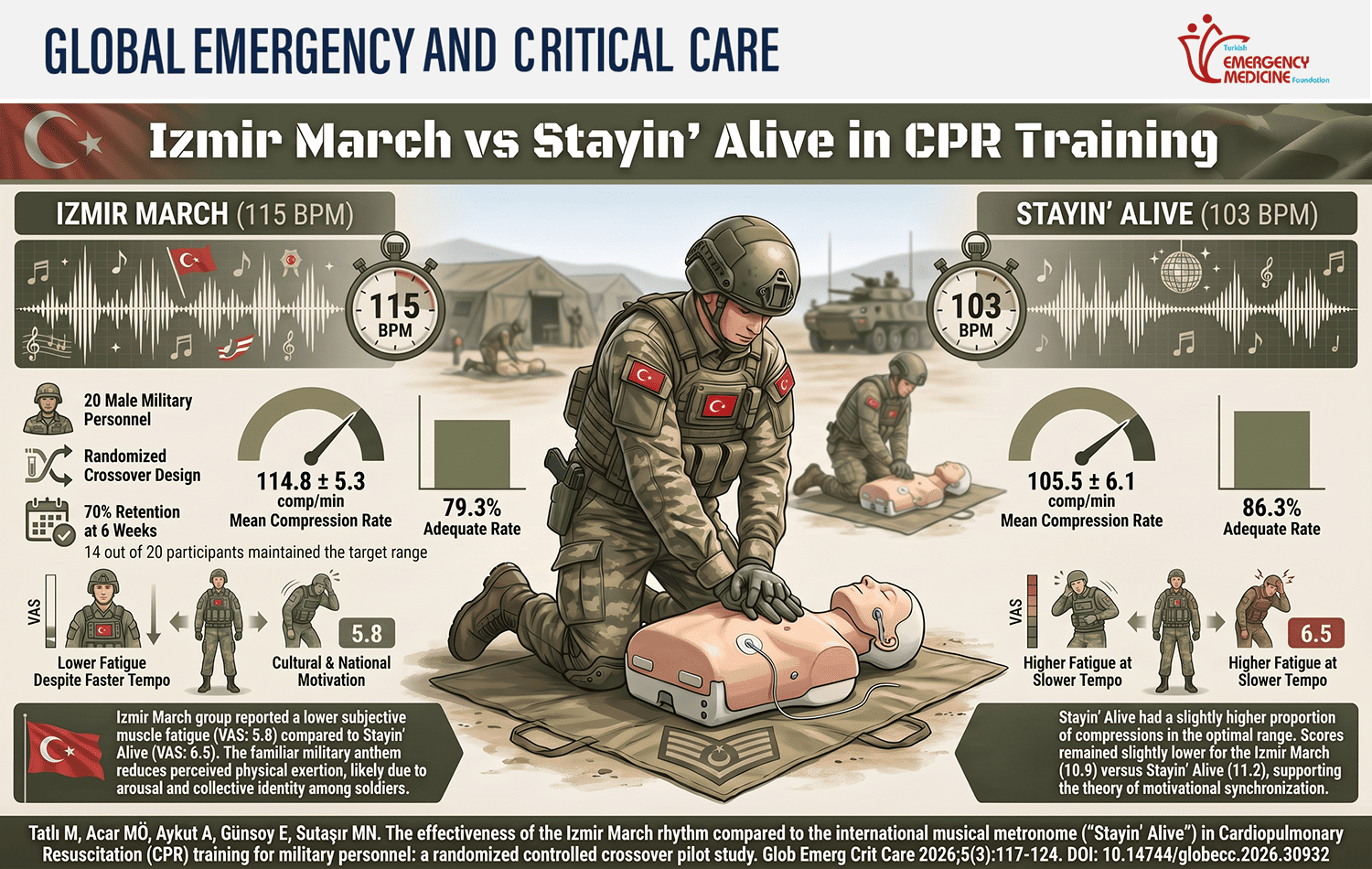
Tatlı M, Acar MÖ, Aykut A, Günsoy E, Sutaşır MN. The Effectiveness of the İzmir March Rhythm Compared to the International Musical Metronome (“Stayin’ Alive”) in Cardiopulmonary Resuscitation (CPR) Training for Military Personnel: A Randomized Controlled Crossover Pilot Study. Glob Emerg Crit Care. 2026 ;5(3):117-124. doi: 10.14744/globecc.2026.30932.
Tatlı M, Acar MÖ, Aykut A, Günsoy E, Sutaşır MN. The Effectiveness of the İzmir March Rhythm Compared to the International Musical Metronome (“Stayin’ Alive”) in Cardiopulmonary Resuscitation (CPR) Training for Military Personnel: A Randomized Controlled Crossover Pilot Study. Glob Emerg Crit Care. 2026;5(3):117-124. doi: 10.14744/globecc.2026.30932
Tatlı, M., Acar, M. Ö., Aykut, A., Günsoy, E., & Sutaşır, M. N. (2026). The Effectiveness of the İzmir March Rhythm Compared to the International Musical Metronome (“Stayin’ Alive”) in Cardiopulmonary Resuscitation (CPR) Training for Military Personnel: A Randomized Controlled Crossover Pilot Study. The Global Emergency and Critical Care, 5(3), 117-124. https://doi.org/10.14744/globecc.2026.30932
Tatlı, M., et al. "The Effectiveness of the İzmir March Rhythm Compared to the International Musical Metronome (“Stayin’ Alive”) in Cardiopulmonary Resuscitation (CPR) Training for Military Personnel: A Randomized Controlled Crossover Pilot Study." The Global Emergency and Critical Care, vol. 5, no. 3, 2026, pp. 117-124. https://doi.org/10.14744/globecc.2026.30932.
Tatlı, M., et al. 2026. "The Effectiveness of the İzmir March Rhythm Compared to the International Musical Metronome (“Stayin’ Alive”) in Cardiopulmonary Resuscitation (CPR) Training for Military Personnel: A Randomized Controlled Crossover Pilot Study." The Global Emergency and Critical Care 5, no. 3: 117-124. https://doi.org/10.14744/globecc.2026.30932.


 , Mevlüt Özgür Acar2